How to Test Spice Purity at Home: 5 Simple Quality Checks
By Admin
Spices should bring depth, fragrance and character to food—not uncertainty. Yet colour, fineness and a strong first aroma do not always tell the whole story. A spice can look vivid and still contain added colour, foreign seeds or low-value material.
The good news is that a few careful observations can help you spot warning signs in everyday kitchen spices. The five checks below use simple household materials and follow the spirit of consumer guidance published by the Food Safety and Standards Authority of India (FSSAI).
Important: A home test is a screening check, not a purity certificate. It may tell you that a sample deserves closer attention, but only testing by a qualified laboratory can confirm adulteration, contaminants or compliance.
Before you begin: test carefully
Use a clean, transparent glass and fresh room-temperature water.
Work with a small sample and compare it with a trusted reference sample when possible.
Do not taste a spice once you suspect adulteration.
Keep children away from test samples and discard them after observation.
Do not use strong acids, solvents or other laboratory chemicals at home.
These checks are designed to identify visible warning signs. Natural spices vary by crop, origin, maturity and processing, so interpret every result with care.
1. Turmeric powder: look for fast-moving colour
What this screens for: water-soluble artificial colour added to make turmeric appear brighter.
How to test
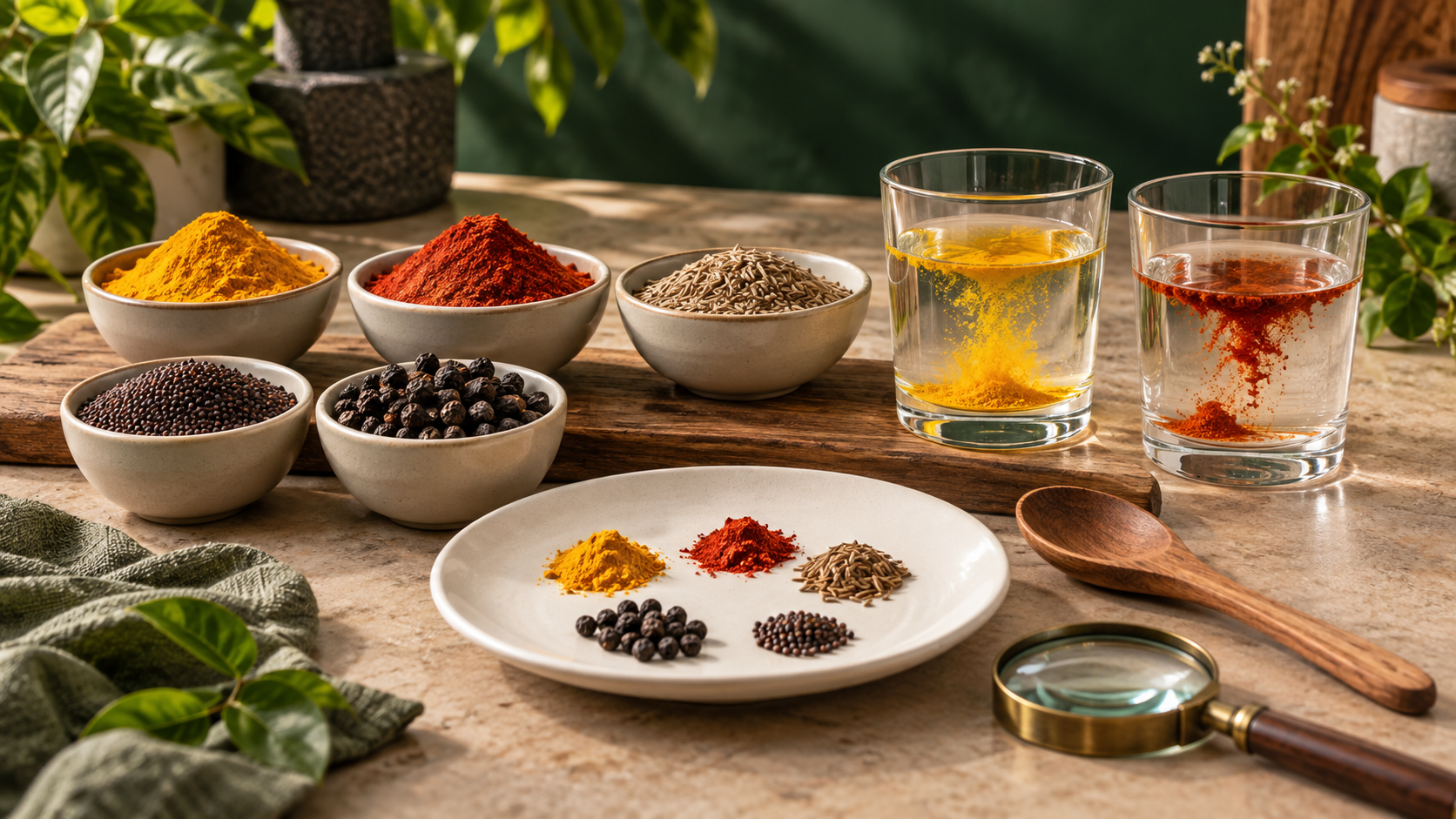
Fill a transparent glass with clean water.
Gently sprinkle a small pinch of turmeric powder on the surface.
Watch the glass without stirring for the first minute.
What to notice: Natural turmeric will colour water as its particles wet and disperse, but distinct, bright-yellow streaks travelling down immediately can be a warning sign of added water-soluble colour.
Do not rely on a “20-minute settling rule.” Particle size, grinding method and moisture can all change how quickly turmeric floats, disperses or settles. This test is best used to notice an unnatural release of colour—not to declare a sample pure.
2. Red chilli powder: watch for colour streaks and gritty sediment
What this screens for: added water-soluble colour and heavy gritty material such as sand or brick-like matter.
How to test
Take a glass of clean water.
Sprinkle a small quantity of chilli powder over the surface; do not stir.
Observe the movement of colour, then allow the sample to settle.
What to notice: Immediate red streaks descending through the water may indicate added colour. After settling, rub only a tiny amount of the bottom residue between wet fingertips. A distinctly gritty feel can suggest earthy or sandy material.
Chilli naturally contains colour and oil, so some tint is expected. The warning signs are an unusually rapid release of intense colour or a clearly gritty residue. Wash your hands thoroughly and keep them away from your eyes.
3. Cumin seeds: try the dry-palm test
What this screens for: grass seeds or other look-alike material coated with charcoal dust to resemble cumin.
How to test
Place a small amount of dry cumin seeds in a clean, dry palm.
Rub the seeds gently between both palms.
Check your skin for dark transfer.
What to notice: A black, charcoal-like residue on the palms is a warning sign. Genuine cumin should retain its characteristic brown-grey appearance and warm, earthy aroma rather than leave a black coating.
This is one reason whole spices offer a useful visual advantage: shape, surface, uniformity and foreign matter are easier to inspect before grinding.
4. Mustard seeds: compare the surface and the centre
What this screens for: argemone seeds mixed with mustard. Argemone is unsafe and a suspicious sample should not be consumed.
How to test
Spread a small sample on a white plate under good light.
Look for seeds that are darker, rough or grainy compared with the smoother mustard seeds.
Carefully press a few suspect seeds separately with the back of a spoon.
What to notice: Mustard seeds are generally smooth and yellow inside when crushed. Argemone seeds are typically rougher, blackish and white inside. If you see a mixture matching these signs, stop using the batch and seek expert guidance.
5. Black pepper: combine the water test with a visual check
What this screens for: papaya seeds mixed into whole black pepper.
How to test
Add a small handful of whole peppercorns to a glass of water.
Allow the sample to settle without stirring.
Separate any floating seeds and examine them closely.
What to notice: Mature black pepper generally sinks, while papaya seeds may float. Peppercorns have a characteristically wrinkled surface and sharp aroma; papaya seeds tend to look smoother, shrunken and more oval.
Some light or immature pepper berries can also float, so floating alone is not proof. Use the water result together with appearance and aroma, and confirm a doubtful batch through proper testing.
What home spice checks cannot tell you
A kitchen test cannot reliably measure everything that matters. It cannot confirm pesticide residues, heavy metals, microbial contamination, aflatoxins, moisture percentage, volatile-oil content or whether a product meets a declared specification. It also cannot validate an “organic” claim.
For a definitive answer, consumers may approach an FSSAI-notified laboratory or contact the local Food Safety Department. FSSAI also provides public resources through its Check Adulteration at Home guidance and DART consumer booklet. These references are educational resources and do not imply FSSAI endorsement of any business or brand.
A smarter spice quality checklist
The best defence begins before a packet reaches your kitchen:
Read the label: Check the FSSAI licence number, batch or lot number, packing date and best-before information.
Inspect the pack: Avoid torn, damp, swollen or poorly sealed packaging.
Use your senses: Reject spices with musty odour, visible mould, insects or an unnatural surface coating.
Buy the right form: Whole spices are easier to inspect and usually protect their aromatic oils longer; powders offer convenience but demand a dependable source.
Store well: Keep spices airtight, dry and away from sunlight, steam and stove heat.
Treat claims separately: “Organic,” “natural” and “pure” are different claims. Look for appropriate certification and traceable labelling rather than assuming one proves the others.
The Sai Agro approach: clarity from source to shipment
At Sai Agro, quality is not reduced to colour alone. Rooted in Unjha—one of India’s best-known centres for cumin, fennel, coriander and other seed spices—we approach every requirement through the character of the crop and the needs of the buyer.
That means beginning with clear conversations about the spice, grade, quantity, pack format and destination. From there, we coordinate lot selection, cleaning support, buyer-led sorting direction, protective packing and dispatch communication with practical attention to consistency.
For commercial buyers, a meaningful spice quality check goes beyond appearance. Agreed specifications, representative sampling and appropriate laboratory reports provide far stronger assurance than a household test alone. Whether you are sourcing whole spices or powders, evidence and traceability should guide the decision.
Choose evidence over assumptions
Simple home checks can make you a more alert buyer. Use them to spot warning signs—not to make absolute claims. When a sample behaves strangely, smells musty, shows foreign material or produces an unusual colour release, stop using it and seek professional confirmation.
Looking for a dependable bulk spice partner? Speak with Sai Agro about your product, grade, quantity, packaging and destination requirements.
- #spice purity
- #turmeric
- #red chilli
- #cumin
- #mustard seeds
- #black pepper
- #food safety